
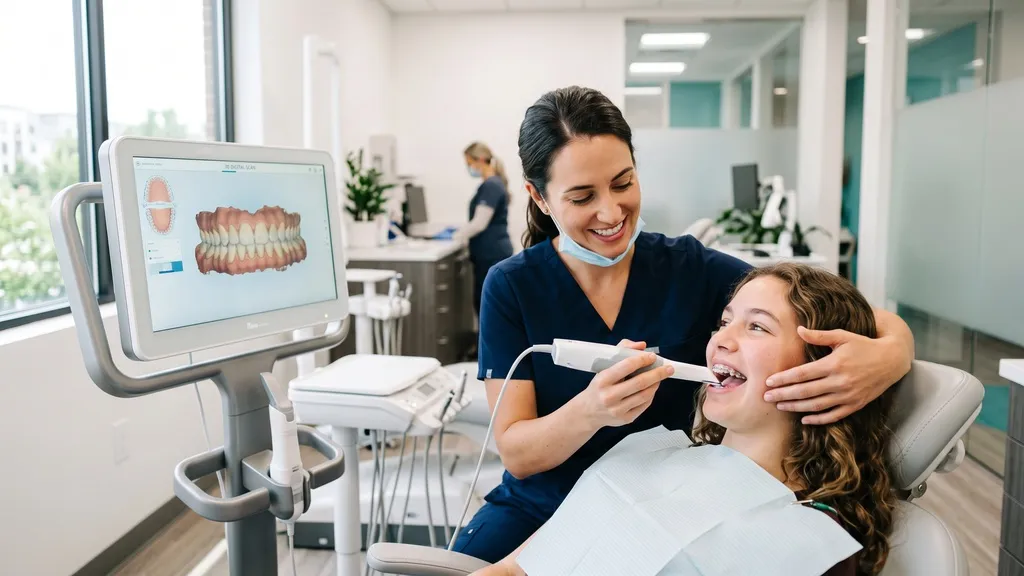
An iTero scanner is a handheld wand that captures a detailed 3D digital model of your teeth and bite, and it takes the place of the tray of putty that orthodontic offices used to press into your mouth. At Wendling Orthodontics, we use the iTero Intraoral Scanner, and a digital scan is often part of the free consultation, so patients get their records taken in a few minutes with no impression material at all. We have been an Invisalign provider since 2000 and are one of the area’s Top Providers, and that same 3D scan is what starts a modern clear aligner therapy plan.
If you are researching orthodontists for yourself or your child, the type of technology a practice uses is a fair thing to ask about. Below we explain what the scanner does, what the scan feels like from the patient’s chair, and why the digital process matters for treatment. We have kept it practical, because comfort and “what will this actually be like” tend to matter as much as the technology itself.
What is an iTero scanner?
An iTero scanner is an intraoral scanner, which means it takes a digital impression of your mouth using light instead of physical molding material. According to the manufacturer, Align Technology, the scanner captures high-resolution 3D images of the teeth and bite and replaces traditional impressions with a digital record.
The result is a rotating 3D model of your teeth that appears on a screen right next to you. Your doctor can turn it, zoom in, and look at how your upper and lower teeth fit together, all from a scan that took a few minutes to capture.
How does an iTero scan work?
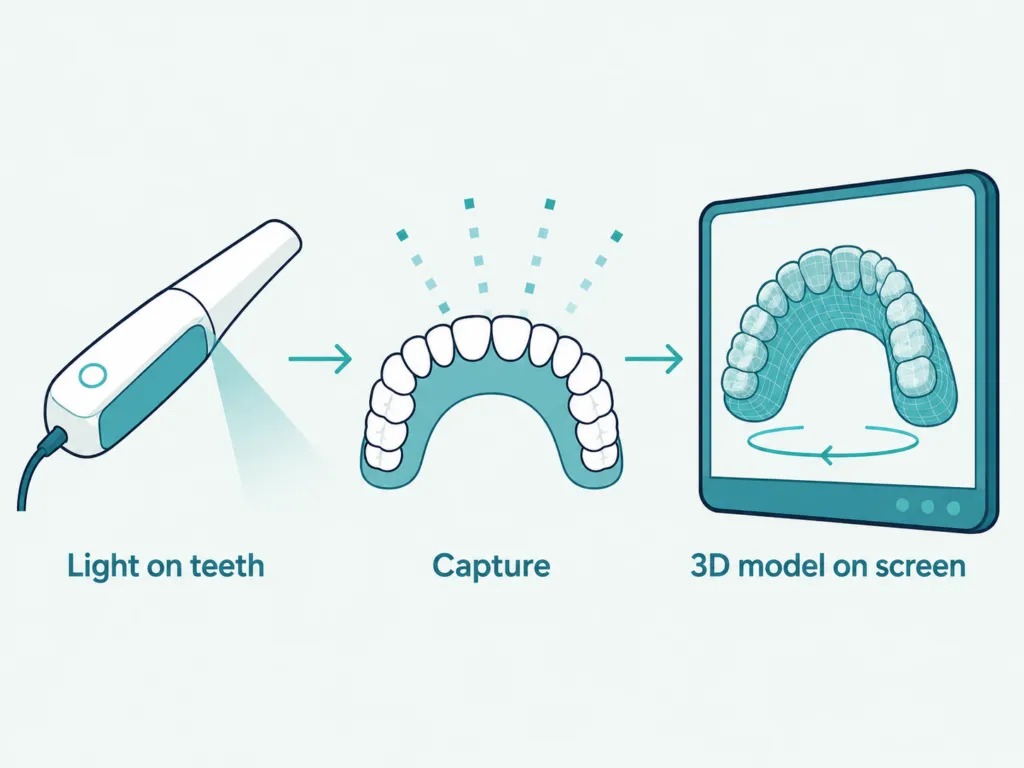
The scanner works by taking an optical impression rather than a physical one. Peer-reviewed reviews of intraoral scanning describe the same basic process: the wand projects a light source onto the teeth, sensors record the reflected images, and software processes those images into a 3D surface model.
For a patient, the plain version is simple. A team member moves a small wand around your teeth. The wand records what it sees, and the software stitches those views together into a 3D model as the scan happens. There is no tray, no putty, and nothing to bite down on and hold still.
The exact internal method depends on the scanner generation, so it is fair to say that not every iTero model captures images in precisely the same way. What stays consistent for the patient is the experience: a light-based scan that builds a digital model on screen.
What an iTero scan feels like from the chair
One of the clearest differences from the old approach is that you can watch the scan appear in real time. The manufacturer’s materials note that images show up on screen instantly and that the system processes the scan while the operator is still working. Studies of intraoral scanning describe the same thing, with the on-screen image viewable throughout so any missing area can be checked on the spot.
That real-time view leads to a practical advantage. If the team needs one more angle, they can usually add it right then instead of starting over. With a traditional putty impression, a problem often is not obvious until later, and fixing it can mean taking the whole impression again.
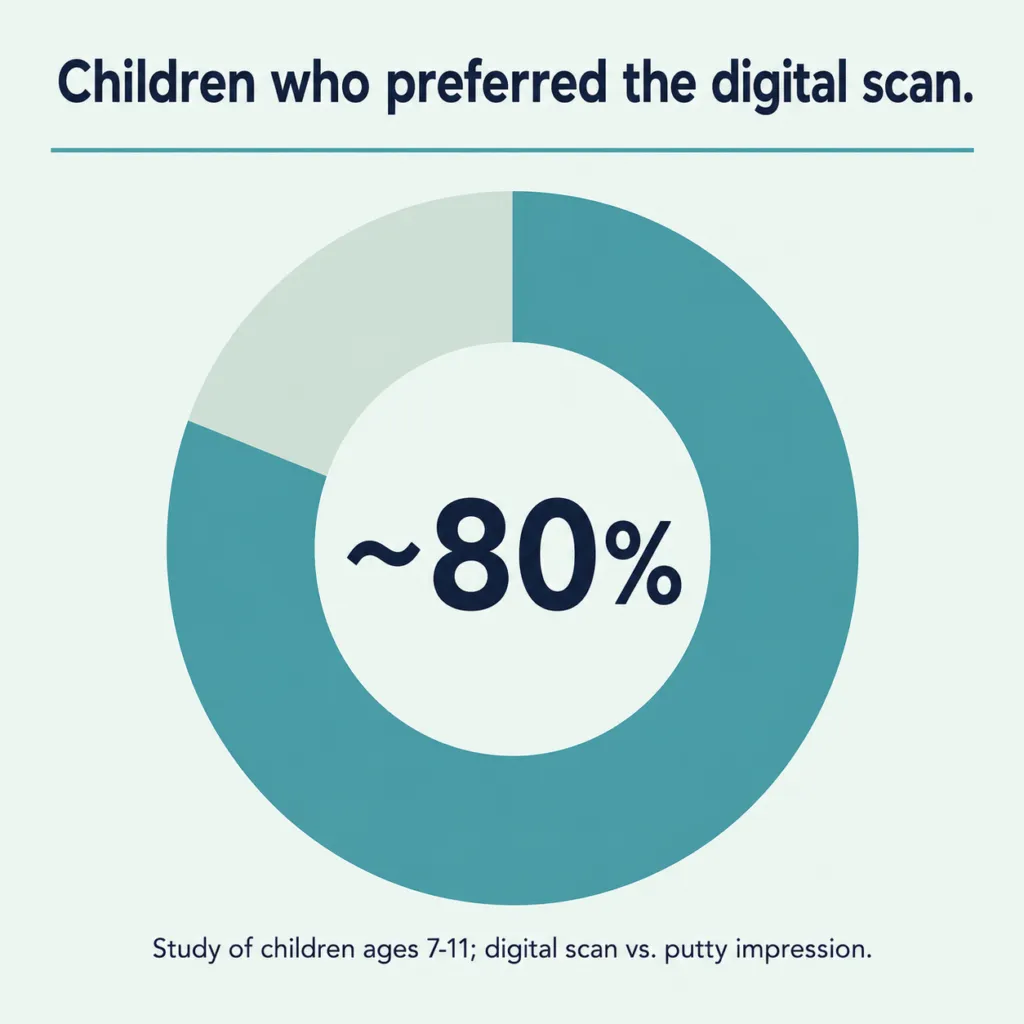
For younger patients and for anyone with a sensitive gag reflex, the scan is generally the easier experience. Research on digital scanning has consistently found that patients tend to prefer it over conventional putty impressions and report more comfort and less gagging. In a recent pediatric study of children ages 7 to 11, about 80 percent preferred the digital scan, and the digital scan was both more comfortable and faster than the rubber-base impression.
iTero scan vs. traditional putty impressions
Here is how a digital scan compares with the conventional putty impressions many people remember from years past.
| Feature | Digital iTero scan | Traditional putty impression |
|---|---|---|
| How records are taken | A light-based wand moves around your teeth | A tray of putty is pressed onto your teeth and held in place |
| Comfort | Generally better tolerated, with less gagging reported | More likely to trigger a gag reflex for some patients |
| Speed | Typically a few minutes | Sets in the mouth, then a model is poured separately |
| Fixing a missed area | The team can usually rescan just that spot | Often requires remaking the entire impression |
| What you see | A 3D model appears on screen as the scan happens | A physical mold you review after it is poured |
| What happens next | The digital file feeds directly into treatment planning | The physical impression is shipped and converted later |
Is an iTero scan the same as an x-ray?
No. An iTero scan is an optical scan of the surface of your teeth, and it is not a dental x-ray. The scanner uses light to build a 3D picture of the teeth and bite. It is a different tool from the digital panoramic x-ray, which we also take during a consultation to see the teeth, jaw, and bone structure.
Some iTero models include a near-infrared imaging feature that can help view between the teeth without harmful radiation, according to Align. That capability is specific to certain scanner models and is not a feature of the technology in general.
How long does an iTero scan take?
For most patients, the scan takes a few minutes. Align’s own comparison materials list a full-mouth scan of under 60 seconds and a single-arch scan of under 30 seconds, though those figures come from manufacturer benchmarks and vary by scanner model. The honest answer is that timing depends on the scanner, the arch being scanned, and how complex the case is, but the scan is quick compared with waiting for putty to set.
How iTero scanning supports clear aligner therapy
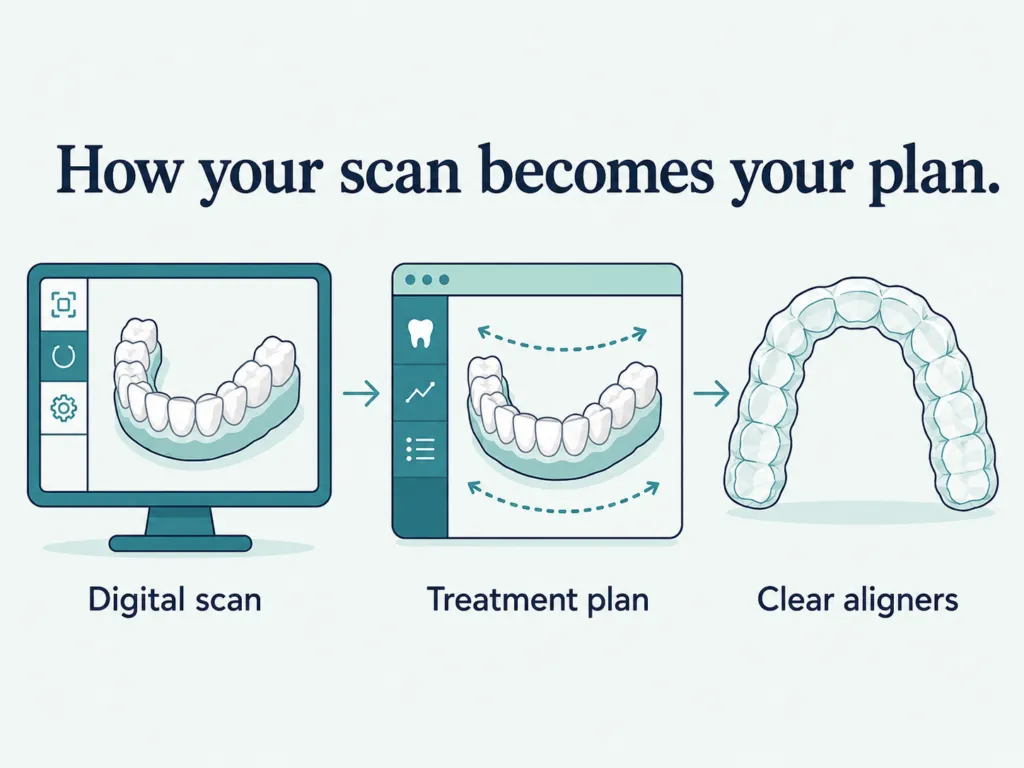
For clear aligner therapy, the scan does more than take records comfortably. It is the starting point of the plan. Align’s materials are clear that iTero scans feed directly into Invisalign treatment planning, so your digital model becomes the basis for designing your aligners instead of a physical impression being shipped and converted later.
Digital orthodontic workflows now commonly begin with an intraoral scan, and peer-reviewed orthodontic literature describes the scan as a standard first step for planning clear aligners and other custom appliances. Align also reports that Invisalign cases started with an iTero scan are posted to its planning system faster and see fewer fit issues than cases started with putty impressions. Those are manufacturer figures rather than independent findings, so we present them as what Align reports.
This is where our experience comes in. We have worked with clear aligner therapy since 2000, and the 3D scan is the front end of that process. When you come in, Dr. Wendling, Dr. Perry, or Dr. Nolan reviews your scan, examines your teeth, and builds a plan based on what your specific situation calls for.
Can the scan show what my smile could look like?
Sometimes, yes. Certain iTero models include an outcome simulation feature that can show a projected version of your smile after treatment, right there on the screen. Align describes this as a simulated visualization of a potential future smile.
It is a helpful way to understand the plan before treatment begins. Keep in mind that it is a projection based on the treatment plan, not a promised final result.
How accurate are digital scans?
Digital intraoral scans are accurate enough for routine orthodontic records and for many digital treatment workflows. Systematic reviews report satisfactory to excellent reproducibility, shorter scanning time, and improved patient comfort with intraoral scanning.
Accuracy does depend on the situation. Full-arch scans and more complex cases can be more challenging, and factors like scanner model, technique, and the anatomy of the mouth play a role. The reasonable takeaway is that digital scanning is reliable for everyday orthodontic use, with clear benefits in comfort and efficiency, even if it is not flawless in every scenario.
When will I have my first iTero scan?
For most of our patients, the first scan happens at the free initial consultation. Along with comprehensive photos and a digital panoramic x-ray, a digital iTero scan is often part of that visit, and there is no charge or obligation for the consultation.
From there, Dr. Wendling, Dr. Perry, or Dr. Nolan will talk through your options, whether that points toward clear aligners or traditional braces, and answer whatever questions you have. If you would like to see the modern experience for yourself and get a straight answer about your smile, we would be glad to meet you. Call our Flint office at 810-733-3410 or our Grand Blanc office at 810-214-3711, or reach out through wendlingortho.com to schedule your free consultation.