
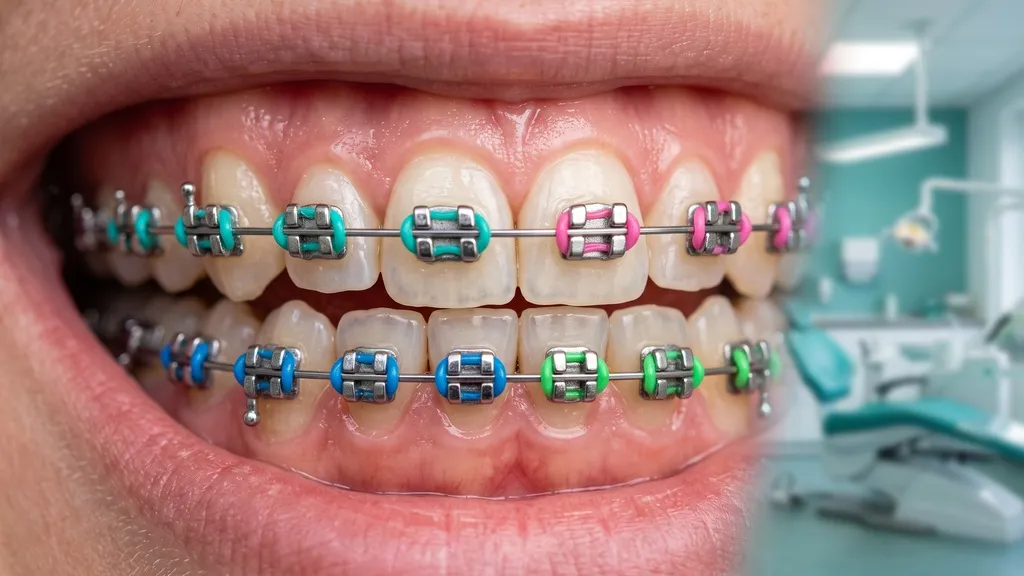
A crossbite happens when some of the upper teeth sit inside the lower teeth when the mouth closes. How it gets corrected depends on the type of crossbite, the patient’s age, and whether the problem comes from tooth position or from the jaw itself. Those three variables decide whether the answer is a palatal expander, braces, clear aligner therapy, a growth-modification appliance, or, in a small number of adult cases, jaw surgery. At Wendling Orthodontics, we have treated crossbites across every age group since 1998, and one of our three orthodontists, Dr. Lisa K. Wendling, Dr. Jessica Perry, or Dr. Nolan Wendling, personally evaluates every patient to match the treatment to the specific bite. That evaluation is the real starting point, because two crossbites that look alike in the mirror can call for very different treatment underneath.
What is a crossbite?
A crossbite is a type of malocclusion, which simply means the upper and lower teeth do not meet the way they should. In a normal bite, the upper teeth rest slightly outside the lower teeth. In a crossbite, one or more upper teeth close inside the lower teeth instead.
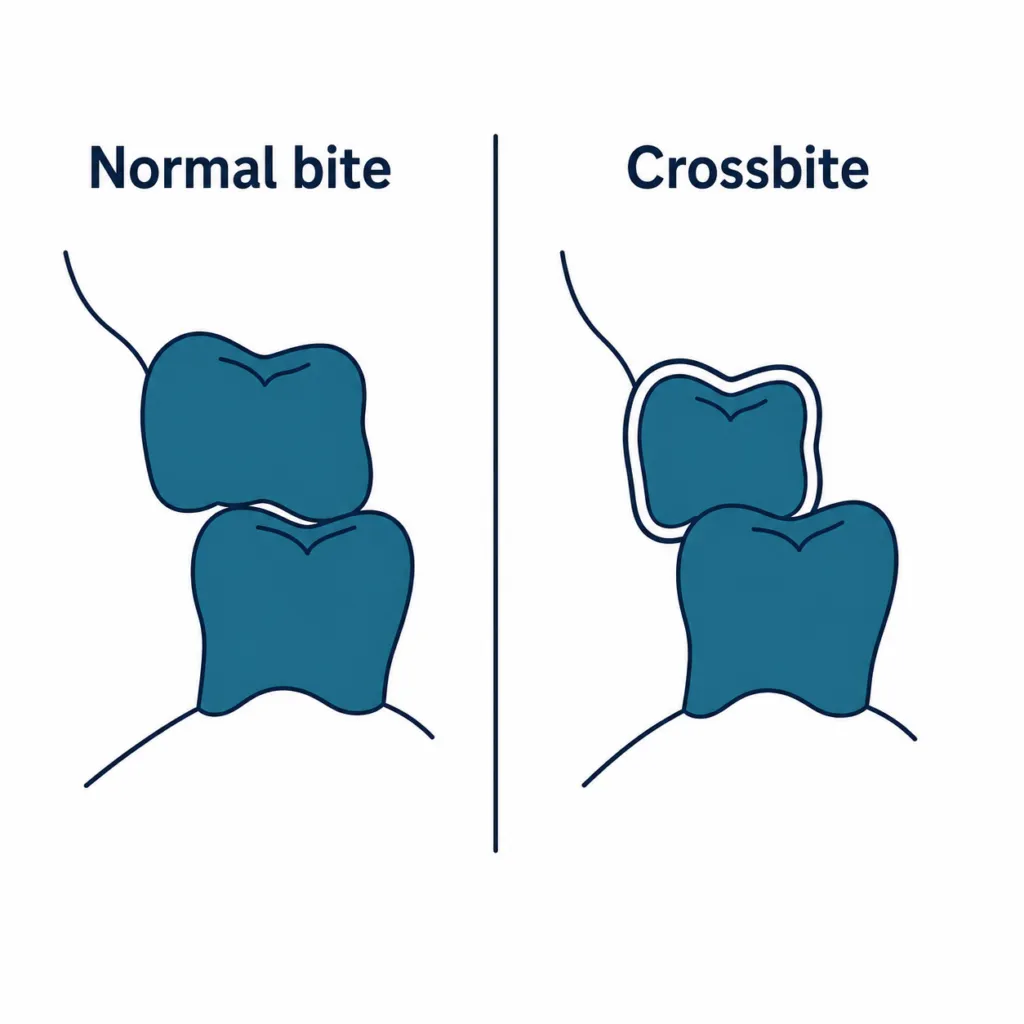
A crossbite can involve a single tooth or several teeth, and it can show up on one side of the mouth (unilateral) or both (bilateral). It is different from an overbite, which is a vertical overlap of the front teeth, and from an underbite, where the lower front teeth sit ahead of the uppers. You can read more about how crossbites are classified through the American Association of Orthodontists.
Anterior vs. posterior crossbite
Crossbites usually fall into two main categories, and the difference matters because each points toward different treatment.
| Crossbite type | What happens | Common signs |
|---|---|---|
| Anterior | One or more upper front teeth close behind the lower front teeth | When all of the upper front teeth sit behind the lowers, people often call it an underbite |
| Posterior | The upper back teeth bite inside the lower back teeth | One of the more common bite problems seen in growing children |
Some patients have elements of both. Posterior crossbites also deserve a closer look, because what appears to be a one-sided crossbite can sometimes be a narrowing of the whole upper jaw, with the lower jaw shifting to one side to find a comfortable bite. Sorting that out is part of the evaluation.
Dental vs. skeletal crossbite and why it drives treatment
More than anything else, the right treatment depends on whether a crossbite is dental or skeletal.
- A dental crossbite is mainly a tooth-position problem. The jaw is a normal size, but one or more teeth erupted or tipped into the wrong spot.
- A skeletal crossbite is mainly a jaw problem, most often a narrow upper jaw. The teeth may be fine on their own, but the bone they sit in is too narrow or positioned incorrectly.
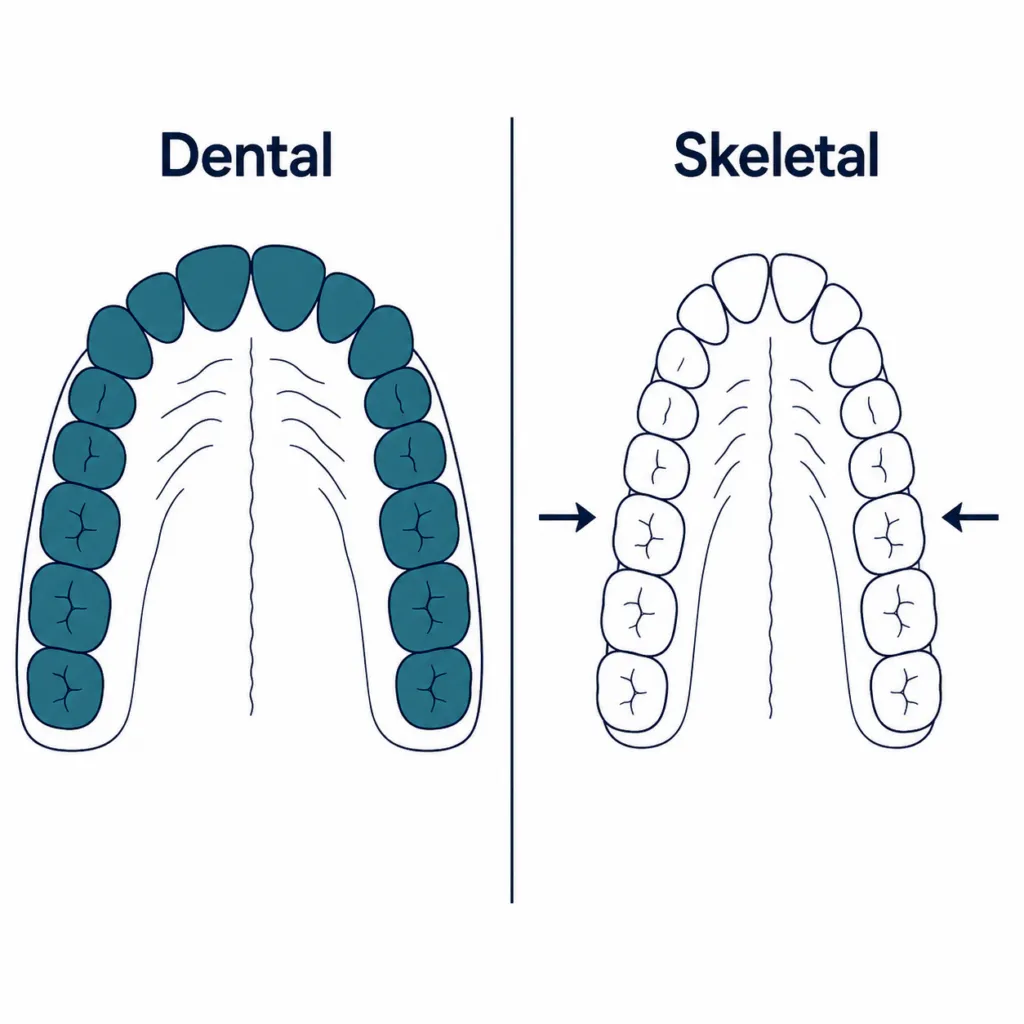
This matters because braces and clear aligners move teeth, but they do not widen or reposition the jawbone the way an expander or, in severe adult cases, surgery can. A dental crossbite can often be corrected by moving teeth. A skeletal crossbite usually needs an appliance or approach that changes the jaw structure, frequently followed by braces or aligners to finish the alignment.
What causes a crossbite?
Crossbites often come from a mix of inherited jaw shape and early childhood habits. Commonly cited contributors include:
- Genetics and inherited jaw relationships
- Prolonged thumb or finger sucking
- Pacifier use past the toddler years
- Mouth breathing
- Tongue thrusting or immature swallowing patterns
- Delayed loss of baby teeth or teeth erupting out of position
Not every habit leads to a crossbite, and many crossbites trace back to jaw development rather than any single cause. The MedlinePlus overview of malocclusion covers these contributors in more detail.
Why timely crossbite correction matters
Left uncorrected, a crossbite can contribute to uneven tooth wear, strain on the jaw and muscles, gum problems, and, in growing children, asymmetric jaw development. That said, this is not a reason to panic. The goal is timely evaluation, not rushed treatment.
Correction is often more straightforward while a child’s jaw is still developing, which is one reason the American Association of Orthodontists recommends a first orthodontic checkup by age 7. An early visit does not mean early treatment. In many cases the right call is to monitor a child’s growth and start later, or to find that no treatment is needed at all.
It is also worth knowing that some childhood crossbites can improve on their own as the permanent teeth come in. How often that happens is unpredictable, which is exactly why an evaluation is more useful than either ignoring the problem or over-treating it.
Crossbite treatment options by age and type
There is no single fix for a crossbite. The options below are matched to age, crossbite type, and whether the problem is dental or skeletal. In our experience, most treatment plans use one of these, and skeletal cases sometimes use two in sequence.
| Treatment | What it addresses | Typically used for | Common age range |
|---|---|---|---|
| Palatal expander (RPE) | A narrow upper jaw (skeletal) | Posterior crossbites tied to a narrow maxilla | Growing children and young teens |
| Braces | Tooth position (dental) | Dental crossbites and the alignment phase after jaw correction | Children, teens, and adults |
| Clear aligner therapy | Tooth position (dental), mild to moderate | Selected dental crossbites | Teens and adults |
| Reverse-pull facemask | Jaw growth (skeletal) | Certain anterior crossbites and underbite patterns | Growing children |
| Jaw surgery | Jaw structure (severe skeletal) | Severe skeletal crossbites after growth is complete | Adults |
Palatal expanders for a narrow upper jaw
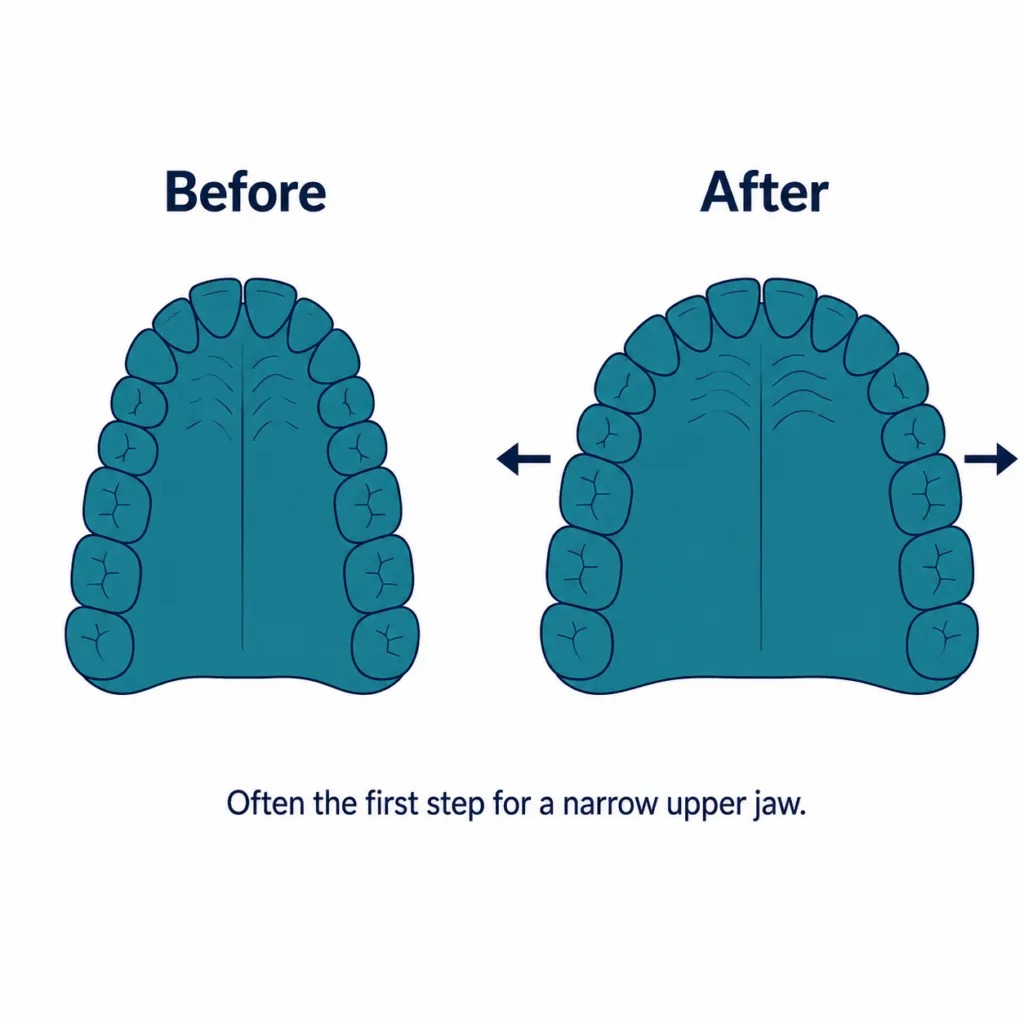
A palatal expander, including the rapid palatal expander (RPE), gently widens a narrow upper jaw. It is most commonly used in growing children and young teens, whose jaws are still developing and respond well to expansion. For a posterior crossbite caused by a narrow maxilla, an expander is often the first step, followed by braces or aligners to align the teeth once there is enough width. The Cleveland Clinic’s palate expander guide explains the mechanics and typical timelines. Expanders are a core part of our early orthodontic treatment for younger patients.
Braces for dental crossbites
Braces are the most versatile crossbite treatment because they can move teeth in children, teens, and adults. They are especially useful for dental crossbites, where the jaw size is fine and the issue is tooth position. Braces also handle the alignment phase that often follows skeletal correction like expansion. You can learn more about our braces options and how they work.
Clear aligner therapy for mild to moderate crossbites
For selected mild to moderate dental crossbites in teens and adults, clear aligner therapy can be a good option. The evidence is clearest that aligners work well for mild to moderate tooth movement, and less so for severe cases or for widening a narrow jaw, which is better handled by an expander. During a consultation, we can tell you whether a crossbite falls within what aligners do well. See our Invisalign and clear aligner page for more.
Reverse-pull facemask for certain anterior crossbites
Some anterior crossbites in growing children are really jaw-growth problems, tied to an underbite pattern, rather than simple tooth-position issues. In those cases, a reverse-pull facemask (also called a protraction facemask) can gently guide the upper jaw forward while the child is still growing. It is usually paired with an expander. Because it depends on active growth, this approach is generally reserved for younger patients and is another part of early treatment.
Jaw surgery for severe skeletal cases in adults
For a small number of severe skeletal crossbites in adults, whose jaws have finished growing, orthodontic appliances alone may not be enough to change the jaw structure. In those cases, orthognathic (jaw) surgery may be part of the plan. This is coordinated with an oral and maxillofacial surgeon, with the orthodontist managing tooth alignment before and after the procedure. It is the least common path, reserved for the most severe adult cases, and the Mayo Clinic’s overview of jaw surgery is a good reference for what it involves. At Wendling Orthodontics, our role in these cases is the evaluation and the orthodontic components. We do not perform jaw surgery.
How long does crossbite treatment take?
Treatment length follows the diagnosis, so there is no single answer. As general ranges, palatal expansion often takes a few weeks to several months of active widening, followed by a holding period. Braces typically run about one to three years. Facemask treatment commonly lasts several months to a year and a half. When jaw surgery is involved, the combined orthodontic and surgical process usually spans two to three years. We give every patient a personalized timeline once we have examined the bite.
Can adults get a crossbite fixed?
Yes. Healthy teeth can be moved at any age, and about 25% of our patients are adults. The main difference is that once the jaws have finished growing, tooth movement alone cannot produce the same jaw changes possible in a still-growing child. For adults, that usually means braces or clear aligners for dental crossbites, and, for severe skeletal cases, a surgical option. The ADA notes that orthodontic treatment can be done at any age as long as the teeth and gums are healthy. Our adult orthodontics page has more on treatment later in life.
The real first step is getting the bite evaluated in Flint, MI
Because the right treatment depends on the type of crossbite, the age of the patient, and whether the problem is dental or skeletal, the single most useful thing you can do is have the bite evaluated by an orthodontist who treats crossbites across all ages. A diagnosis is what turns “there is a crossbite” into a specific plan.
At our Flint orthodontic office, that evaluation starts with a free consultation. We map the bite and jaw using a 3D iTero intraoral scanner and digital panoramic x-rays, with no messy impressions, and one of our orthodontists, Dr. Wendling, Dr. Perry, or Dr. Nolan, personally examines the patient and reviews the options. Our approach is conservative: the right treatment at the right time, with early intervention recommended only when it offers a clear benefit. We serve families in Flint, Grand Blanc, Burton, Fenton, Davison, Swartz Creek, and the surrounding Genesee County communities.
Schedule your free crossbite consultation
If a dentist has flagged a crossbite, or you have noticed a bite that does not look quite right in yourself or your child, the next step is a look from an orthodontist. We will tell you honestly whether treatment is needed now, later, or not at all. Schedule a free consultation at our Flint office by calling 810-733-3410, and we will help you understand exactly what the bite needs.