
There is no single age when kids get braces. The right time depends on how a child's jaw is growing and how their permanent teeth are coming in, not on a birthday. As a practical guide, the American Association of Orthodontists recommends a first orthodontic check-up by about age 7. A smaller group of children benefit from early treatment between ages 7 and 10. And most kids who need full braces get them once most of their permanent teeth have come in, often between ages 11 and 14.
At Wendling Orthodontics, children and teenagers make up about 75% of the patients we see, and we've been guiding families through these decisions since 1998, today from our offices in Flint and Grand Blanc. We believe in the right treatment at the right time. That means we don't put braces on a child a moment sooner than it helps, and we don't want any family to feel like they've missed a window either. Here's how the timing actually works, stage by stage.
Why there's no single age for braces
Two kids who are the exact same age can be at very different points in their dental development. One might still have a mouthful of baby teeth, while another has already lost most of them. Because a child's "dental age" often doesn't match the number on their birthday, orthodontists time treatment around physical milestones instead.
The milestones that matter most are how the jaw is growing and which permanent teeth have erupted. Watching those signals is what tells us whether a child is ready, whether they would benefit from early help, or whether the best move is simply to keep an eye on things for a while.
Why your child's first orthodontic visit should be around age 7
The American Association of Orthodontists recommends that every child have a first orthodontic evaluation by age 7. We generally like to see young patients once their front permanent teeth start to appear, which usually happens between ages 6 and 10.
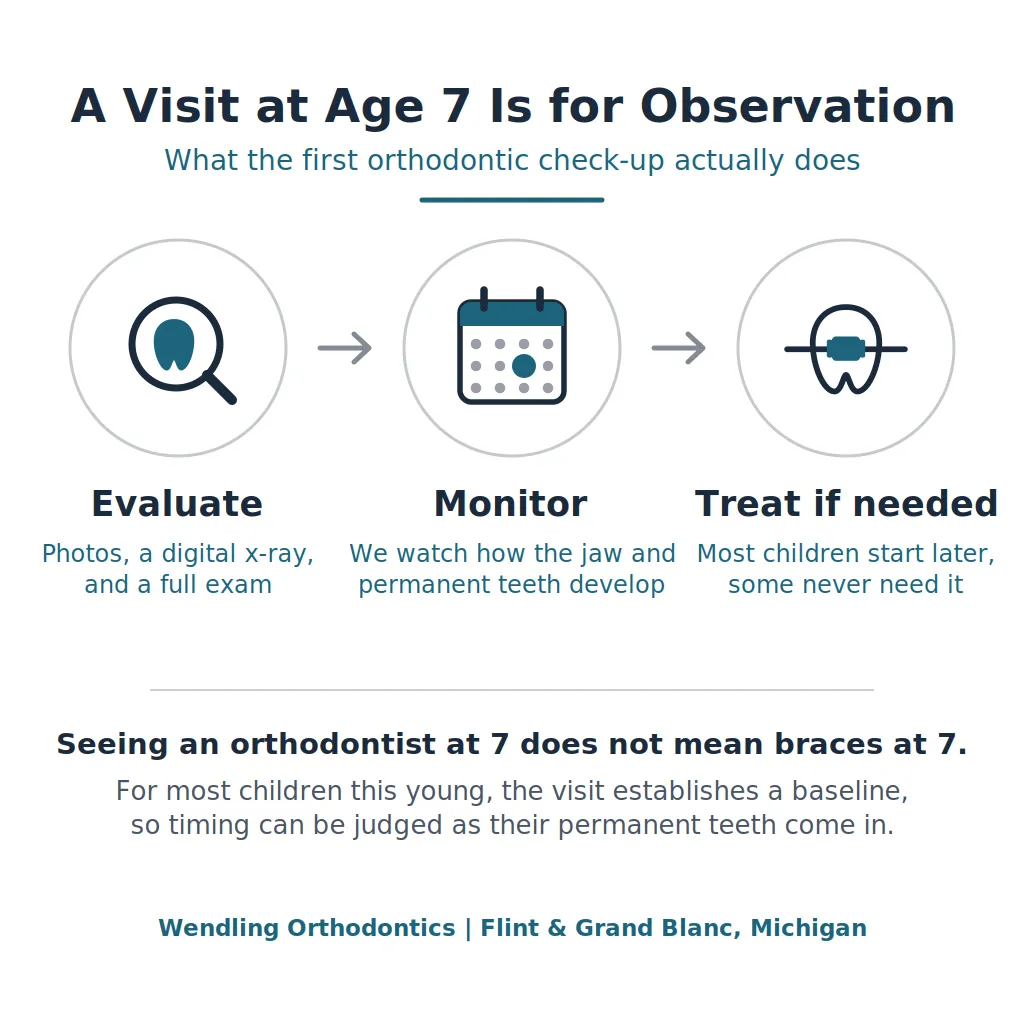
Age 7 works as a baseline because, by then, enough has happened in a child's mouth for an orthodontist to see what's coming. The first permanent molars and front permanent teeth have typically erupted or are erupting, which lets us assess how the bite is developing and how much room there is for the teeth still on the way. During a free consultation, a digital panoramic x-ray helps us map where unerupted teeth are sitting beneath the gums, so we can spot issues like crowding, missing teeth, or teeth heading in the wrong direction long before they become a problem.
Does a visit at 7 mean braces at 7?
Usually not. For most children seen this young, the visit is about observation, not treatment. We establish a baseline, then watch how everything develops. The biggest benefit of an early visit is often peace of mind for parents, along with a clear plan for if and when treatment should begin.
Early treatment, or Phase I, between ages 7 and 10
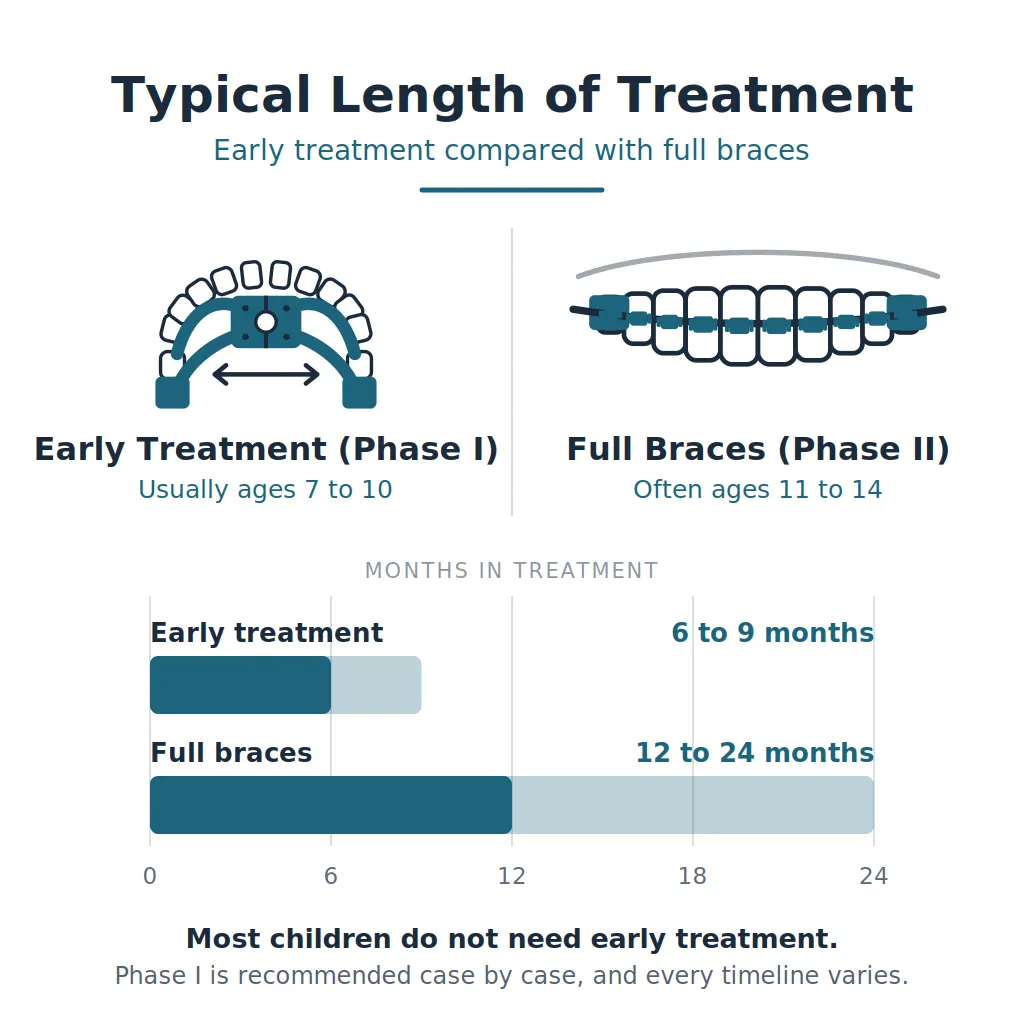
Early treatment, also called Phase I or interceptive treatment, is orthodontic work that begins while a child still has some baby teeth. It usually takes place between ages 7 and 10, and it lasts around 6 to 9 months.
The important thing to understand is that most children do not need it. Phase I corrects specific structural problems while a child's bones are still growing and easier to guide. When one of those problems is present, treating it early can make later treatment simpler and sometimes help a child avoid more involved procedures down the road. When it isn't present, early treatment offers no real advantage over waiting.
For overbites specifically, research summarized in the Cochrane reviews found that treating in two phases is generally no more effective at the final result than a single phase in the teen years. The one exception is prominent front teeth, where pulling them back early can lower the risk of injury. That's exactly why we evaluate each child individually instead of recommending early treatment across the board.
Some of the conditions that may call for early treatment include:
- Crossbites, where the upper teeth sit inside the lower teeth when the jaw closes
- A narrow upper jaw that doesn't leave enough room for permanent teeth
- Underbites, where the lower jaw sits ahead of the upper jaw
- Severe crowding, where incoming permanent teeth have nowhere to go
- Harmful habits like prolonged thumb sucking that are affecting how the jaw and teeth develop
Whether a child is a candidate for any of this is a call that Dr. Wendling, Dr. Perry, or Dr. Nolan makes after a thorough evaluation, never a blanket assumption. You can read more about how we approach this on our early orthodontic treatment page.
What happens after early treatment?
If a child does have Phase I treatment, they don't go straight into braces afterward. They enter our Growing Smiles Supervision Program, where we monitor their growth and incoming permanent teeth every 6 to 9 months. When the time is right, we begin comprehensive treatment at the optimal moment rather than rushing it. Many children who have an early phase often need a second phase later to finish the job.
When most kids get full braces (Phase II)
This is what most people picture when they think about "getting braces." Full or comprehensive treatment, sometimes called Phase II, is the stage where we align all the permanent teeth and correct the bite. It usually happens once most of the permanent teeth have come in, commonly between ages 11 and 14.
The timing lines up with two things happening at once. By the early teen years, the last of the permanent teeth (the second molars and premolars) are typically erupting, and the body is moving through its adolescent growth spurt. According to tooth eruption charts, the lower second molars often come in around ages 11 to 13. Working with that natural growth, rather than after it has finished, lets us move teeth and guide the bite more efficiently. The Cleveland Clinic similarly points to the years between ages 9 and 14 as the general window for comprehensive braces.
For most kids, a single round of comprehensive treatment in this range is all they ever need. Full braces typically take 12 to 24 months, though every child is a little different. You can learn more about the process on our braces and braces for kids pages.
The three stages of children's orthodontics at a glance
| Stage | Typical age | What it's for | Who needs it |
|---|---|---|---|
| First evaluation | By about age 7 | Establish a baseline and spot issues early | Every child, as a check-up |
| Early treatment (Phase I) | Usually 7 to 10 | Correct specific bite and jaw problems while the child is growing | A small subset of children |
| Full braces (Phase II) | Often 11 to 14 | Align all permanent teeth and finalize the bite | Most children who need braces |
What age do kids usually get braces?
Most children who get full braces start somewhere between ages 11 and 14, once most of their permanent teeth have arrived. That said, "usually" isn't "always." The right starting point depends on the individual child's development, which is why an evaluation matters more than a target age.
Is my child too young for braces?
It's very common for parents to worry about this, and the short answer is that bringing a young child in for an evaluation is never too early. A first visit doesn't commit your child to anything. It simply gives an orthodontist the chance to catch anything that benefits from early attention and to reassure you when nothing needs doing yet, which is the most likely outcome.
Is my child too old, or did we miss the window?
You almost certainly haven't missed anything. Healthy teeth can be moved at essentially any age, because the biological process that shifts teeth doesn't stop when childhood ends.
There is one nuance worth knowing. The early teen years are the easiest time to guide jaw growth, so certain bite corrections are simpler then than later on. But for straightening teeth and improving most bites, a teenager who is 15 or 16, or an adult, still has excellent options. About a quarter of our own patients are adults, and they consistently tell us they're glad they didn't keep putting it off.
How do I know if my child needs braces?
Some signs are easier to spot than others. Things parents commonly notice include:
- Crowded or crooked teeth
- Noticeable gaps between teeth
- Upper and lower jaws that don't seem to line up
- Difficulty chewing
- Thumb sucking that has continued past the early years
- Mouth breathing
- Teeth that meet unevenly when biting down
The honest answer, though, is that many of the most important issues sit beneath the gums where you can't see them. That's the real value of a professional evaluation, and the reason the age-7 recommendation exists in the first place.
The best age for braces is the right age for your child
If there's one idea to take away, it's that the best age for braces depends on the child. It's the point where their development and their specific needs line up, and that point is different for every kid.
The easiest way to find it is a free, no-obligation consultation. Dr. Wendling, Dr. Perry, or Dr. Nolan will evaluate your child, explain exactly what they see, and tell you honestly whether it's time to begin or time to wait. If your child is around 7, this is a natural moment for that first visit. If they're older, it's a good time to find out where things stand. Either way, you'll leave with a clear picture and zero pressure.
Ready to find out the right time for your child? Schedule your free consultation at our Flint or Grand Blanc office, and let's take a look together.