
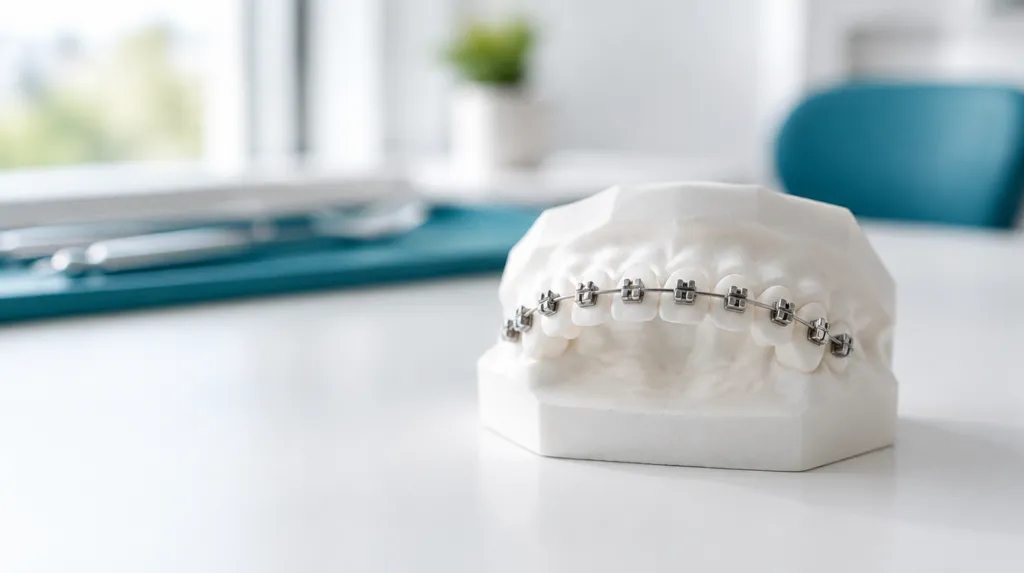
Braces work by applying light, steady pressure to your teeth. That gentle pressure signals the bone around each tooth to reshape itself, which lets the tooth move slowly into a better position and then settle there. The brackets on your teeth and the thin wire running through them create the pressure, and small adjustments along the way keep everything moving according to plan.
If you or your child are about to start treatment, understanding what's happening behind the scenes makes the whole experience feel far less mysterious. At Wendling Orthodontics, we've been walking families through this process since 1998, today from our offices in Flint and Grand Blanc. With thousands of patients treated over the years and roughly 600 in active treatment at any given time, we've gotten good at explaining it in plain language. Here's how braces move teeth, and what you can expect from the first visit to the day the braces come off.
How braces actually move your teeth
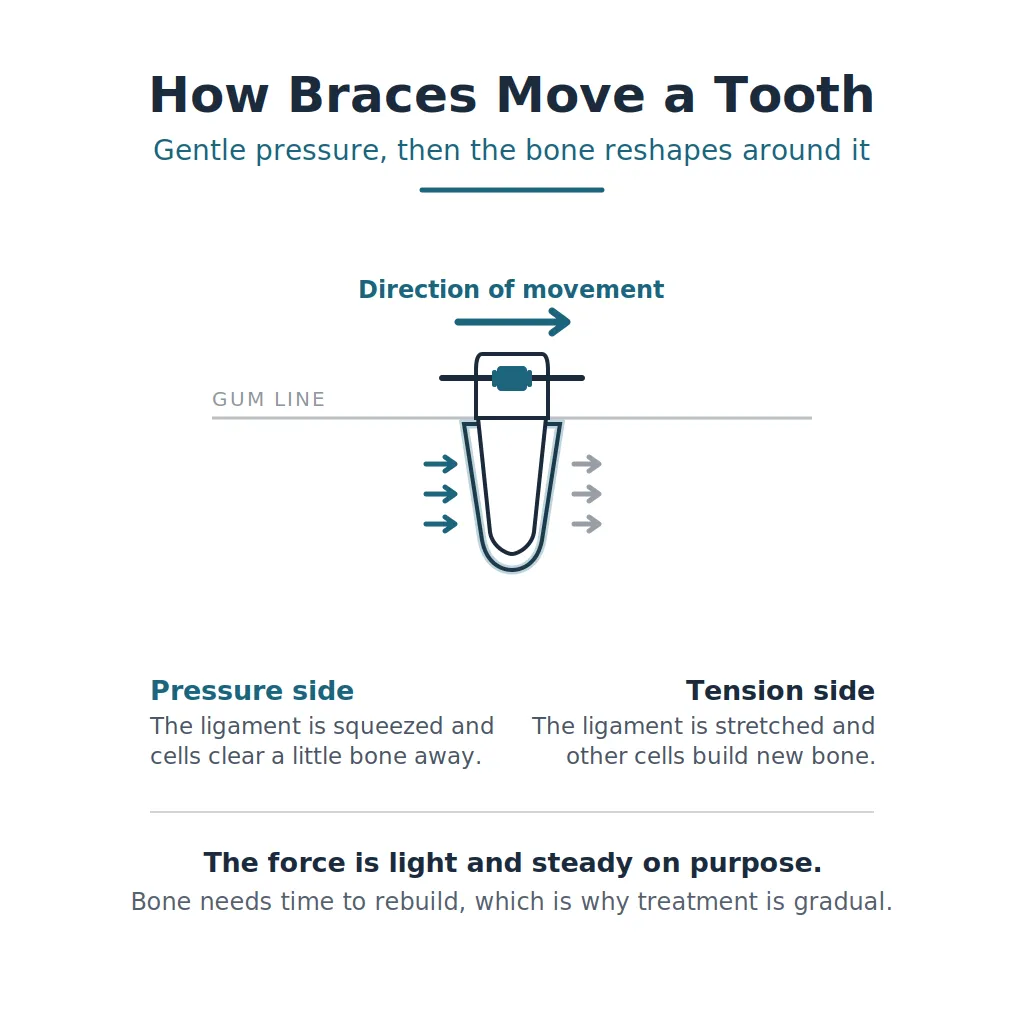
Your teeth aren't fused to your jaw. Each one sits in bone, held in place by a thin cushion of tissue called the periodontal ligament. That ligament is the key to how braces work.
When braces apply gentle pressure to a tooth, the ligament on one side is compressed while the ligament on the other side is stretched. Your body responds by remodeling the bone around the tooth. On the side the tooth is moving toward, cells break down a small amount of bone. On the side it's moving away from, other cells build new bone. This is what lets a tooth change position and then stabilize in its new spot.
It's also why orthodontic treatment is slow and gradual. The force is meant to be light and steady, not fast or forceful, because the bone needs time to reshape itself in a healthy way. You can read more about the biology of how braces move teeth through the Cleveland Clinic, but the short version is simple: gentle pressure, sensed by the ligament, followed by the body slowly rebuilding bone so the tooth can move.
The parts of braces and what each one does
Braces are best understood as a team of small parts, each with a specific job. Once you know what each piece is for, the whole appliance makes a lot more sense.
| Part | What it does |
|---|---|
| Brackets | Small anchors bonded to each tooth that give the wire something to hold onto |
| Archwire | The thin wire threaded through the brackets that applies the gentle pressure that moves teeth |
| Elastic ties (ligatures) | Tiny bands, often colored, that hold the archwire in its bracket slots |
| Elastics (rubber bands) | Worn between the upper and lower teeth to help correct the bite in ways the wire alone cannot |
| Power chains and bands | Added in some cases when a tooth or group of teeth needs extra force |
The brackets are the handles, the archwire does most of the moving, and the small ties keep everything connected. The American Association of Orthodontists describes this same setup for families researching treatment.
The braces we use at our offices are traditional metal braces. One of the small perks for kids and teens is that the elastic ties come in colors, so you can personalize your braces at each visit. Many of our younger patients look forward to switching up their colors to match a holiday, a season, or their favorite team.
What to expect at each stage of braces
Understanding the mechanics helps, but most families also want to know what the experience actually feels like, visit by visit. Here's how the journey usually unfolds.
Step 1: Your free consultation and treatment plan
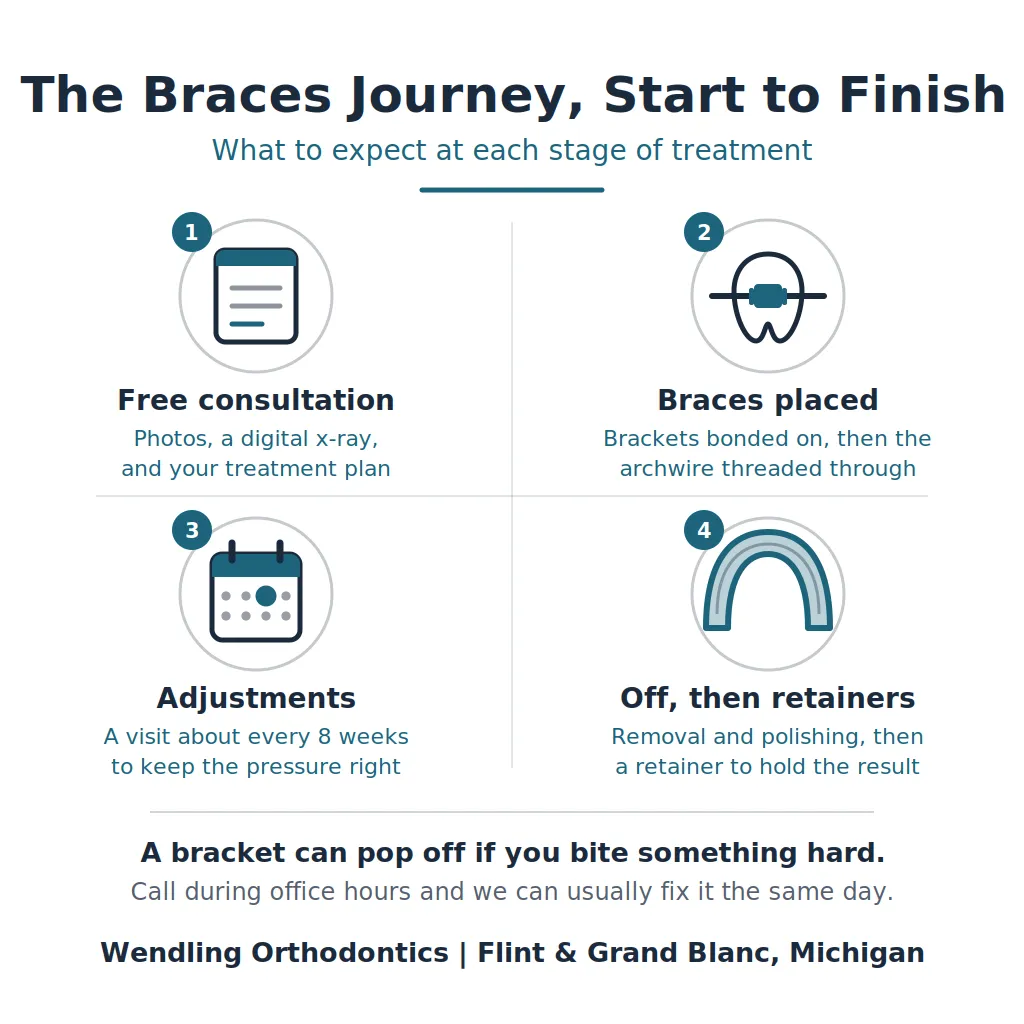
Every braces journey starts with a consultation. At our offices that first visit is free. We take photos and a digital panoramic x-ray, and we often add a 3D scan using our iTero intraoral scanner, which maps your mouth without any messy impressions. From there, Dr. Wendling, Dr. Perry, or Dr. Nolan reviews everything and builds a treatment plan made for your teeth. This is also where we walk you through your options and what you'd invest, so there are no surprises before treatment begins. You can learn more about what happens at a free consultation before you come in.
Step 2: Getting your braces placed
Placing braces doesn't involve any drilling, and most patients find it comfortable. Each bracket is bonded to a tooth, the archwire is threaded through, and the ties are added to hold it all together. The appointment usually takes about an hour. It's normal for teeth to feel a little tender for a few days afterward, and soft foods make those first days easier.
Step 3: Adjustment visits along the way
Once your braces are on, you'll come in for adjustment visits so the pressure stays right for each stage of movement. At our offices these happen about every 8 weeks. At each visit, the doctor at that office personally checks your progress and updates the wire, ties, or elastics as needed.
Life happens, too. A bracket can occasionally pop off if you bite into something hard. If that happens during office hours, we can usually see you the same day to fix it, so a small mishap doesn't slow down your treatment.
Step 4: Taking the braces off
When your teeth have reached their planned positions, the braces come off. Removal is quick, and we polish your teeth afterward. Then you move into the phase that protects all of that work: wearing a retainer.
How long do braces usually take?
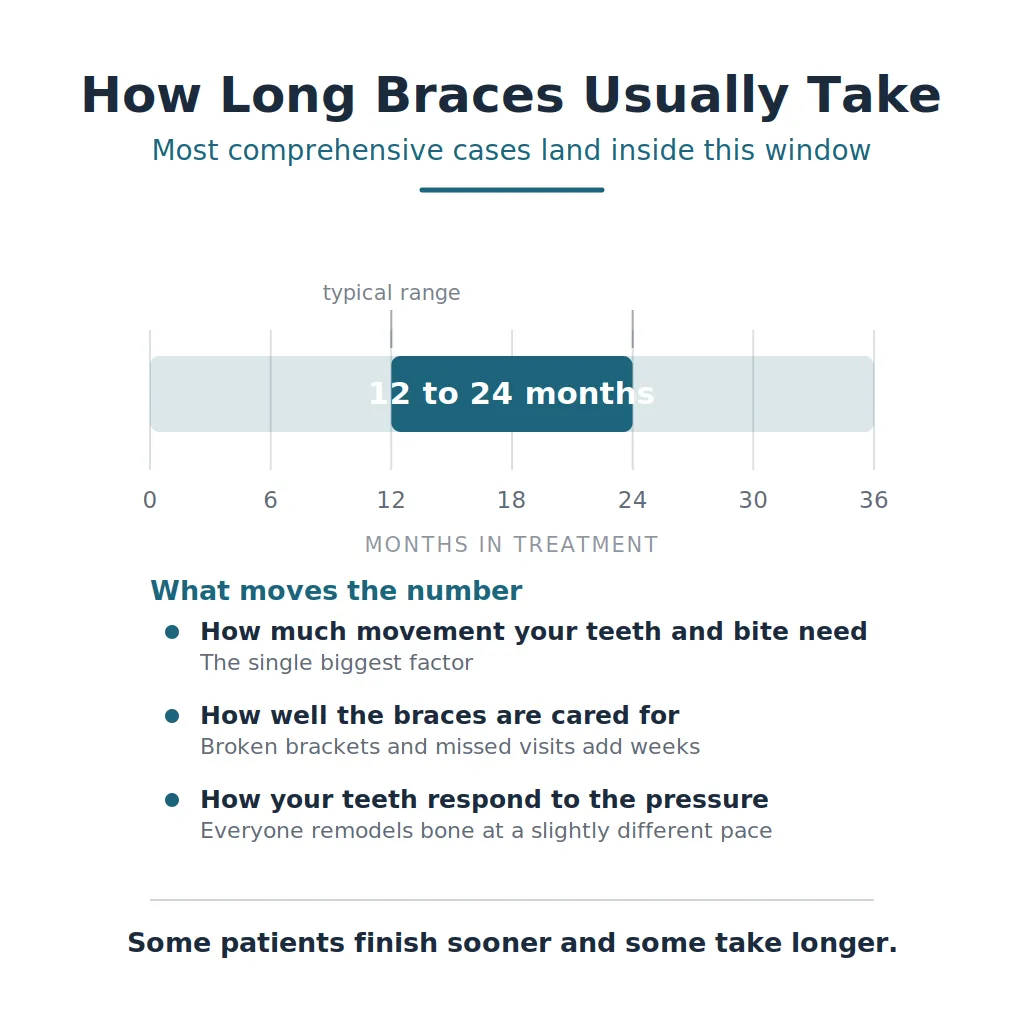
Most comprehensive braces cases fall somewhere in the 12 to 24 month range, though some finish sooner and others take longer. The American Dental Association notes that most people wear braces for one to three years.
The biggest factors are how much movement your teeth and bite need and how well the braces are cared for along the way. Simpler cases can wrap up on the shorter end, while more complex bite corrections take more time. Broken brackets and missed care can also add weeks. During your consultation, we can give you a personalized timeline based on what your teeth actually need.
Do braces work the same for kids, teens, and adults?
Braces move teeth at any age, but the timeline can differ. Children and teens often respond a little faster because they're still growing and their bone is more responsive. That's part of why many orthodontists like to begin comprehensive treatment somewhere around ages 9 to 14.
Adults are still excellent candidates. Because adult bone is more mature and dense, treatment may take slightly longer than it would for a child with a similar issue, but the results are just as real. About a quarter of the patients we treat are adults, so if you're considering braces for yourself, you're in good company.
Keeping your new smile: retainers after braces
Teeth have a natural tendency to drift after treatment, especially in the first months while the surrounding bone and tissue settle. That's exactly what retainers are for. Braces finish the active moving part, and retainers protect the result.
There are two main types of retainers, and no single design is right for everyone:
- Removable retainers, which include clear tray-style retainers and Hawley-style retainers with a wire across the front
- Fixed retainers, which are bonded behind the teeth and stay in place
After treatment with us, you'll usually receive a removable clear retainer for the upper and lower teeth wherever treatment was completed. In certain cases, we may also recommend a fixed retainer behind the upper or lower teeth. You can read more about the different kinds of retainers through the American Association of Orthodontists.
We're honest with our patients about this part. Nothing lasts forever, and teeth can shift over time if a retainer isn't worn as recommended. Wearing your retainer as directed is what keeps your results in place for the long run.
Living with braces day to day
Life with braces is easier than most families expect, and a few simple habits make a big difference:
- Keep them clean. Brush after meals when you can, and floss around the brackets and wires to keep plaque from building up.
- Be smart about food. Limit hard, crunchy, and sticky foods that can damage the appliance. Common culprits include popcorn, whole apples, corn on the cob, caramel, and chewing gum.
- Call if something breaks. If a wire or bracket comes loose, or if soreness doesn't settle the way it usually does, let us know. The American Association of Orthodontists offers similar day-to-day guidance for patients in treatment.
None of this needs to feel overwhelming. Most patients settle into a routine within the first couple of weeks and barely think about it after that.
Getting started with braces in Flint and Grand Blanc
Understanding how braces work is a great first step, and we hope this made the process feel a little clearer. When you're ready to see what treatment could look like for you or your child, we'd love to meet you. You can learn more about braces at our practice, or if you're researching for a child, take a look at our braces for kids page.
When it feels right, schedule a free consultation at our Flint or Grand Blanc office. Dr. Wendling, Dr. Perry, or Dr. Nolan will take the time to answer your questions and help you find the best path to a healthy, confident smile.