Orthodontist Near Me

Invisalign vs Braces: Which Is Right for You?

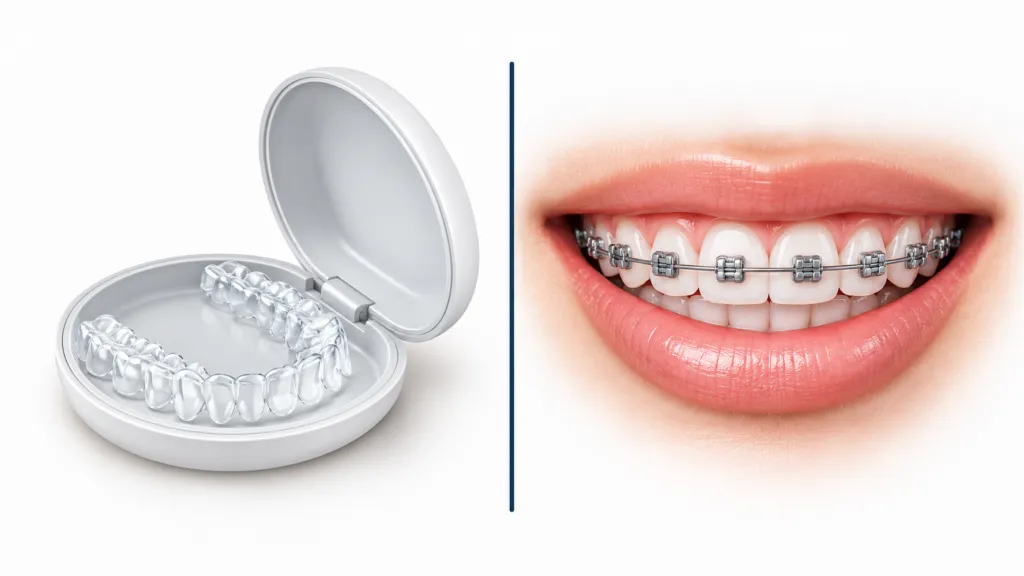
If you are choosing between Invisalign and braces, the honest answer is that both straighten teeth well, and the right choice depends on your situation more than on which option is “better.” Three things usually decide it: how complex your bite is, how much the look matters to you, and how much daily responsibility you want to take on. A clear aligner comes out for meals and photos but only works if you keep it in the rest of the time. Braces stay on and work on their own, but they are visible and come with a few food rules. Which of those tradeoffs fits your life is up to you. To know for sure which option suits your case, though, you need an orthodontist to look at your teeth. At Wendling Orthodontics, we offer both, so we can give you a straight comparison without any reason to push one over the other. We have been an Invisalign® provider since 2000 and have cared for families in Flint and Grand Blanc for more than 27 years, treating kids, teens, and adults. All three of our orthodontists, Dr. Wendling, Dr. Perry, or Dr. Nolan, personally see every patient, so a doctor matches the treatment to your case. Invisalign vs braces: a quick comparison Here is how clear aligner therapy and traditional braces compare on the practical factors most people ask about. Factor Clear aligner therapy (Invisalign) Traditional braces Appearance Clear trays that are hard to notice Metal brackets and wires that show Removable Yes, taken out to eat and clean No, fixed to your teeth Food restrictions None, since you take them out to eat Avoid hard, sticky, crunchy, and chewy foods Daily responsibility Must be worn at least 22 hours a day and not lost No daily wear decisions; they work on their own Cleaning Brush and floss normally, then rinse the trays Extra care needed around brackets and wires Best suited for People who will wear them faithfully and want a removable, hard-to-notice option People who prefer nothing to remember, some complex cases, and young kids who might lose or skip trays Which is less noticeable, Invisalign or braces? Clear aligners are the less noticeable option. They are made of clear plastic that fits over your teeth, so most people will not notice you are wearing them, which is part of why so many teens and adults choose them. Traditional braces use metal brackets and wires, and those show when you smile and talk. If keeping your treatment private matters to you, that difference is real. Plenty of people wear braces happily without giving the look a second thought, so how much this matters is up to you. Can you take them out, and does that matter day to day? The biggest everyday difference is that aligners come out and braces do not. You take a clear aligner out to eat, to brush and floss, and for a photo, then put it back in. Braces are bonded to your teeth and stay on until one of our doctors removes them, so there is nothing to take out or put back. Being able to remove the trays is convenient, and for many people that is a real plus. It also comes with a small responsibility, since an aligner only works while it is in your mouth. You have to remember to put it back in after you eat. What can you eat with each? With clear aligners there is no food list, because you take the trays out to eat. You can have whatever you normally would, then brush and put the aligners back in. The one habit to keep is drinking only water while the trays are in, since sugary or acidic drinks can get trapped against your teeth. With traditional braces, you will need to avoid hard, sticky, crunchy, and chewy foods, like popcorn,and chewing gum, because they can break a bracket or bend a wire. For a lot of families, that food difference is one of the deciding factors. How much daily responsibility does each one take? Clear aligners take real daily discipline, and braces take none. For aligners to work, you have to wear them at least 22 hours a day, taking them out only to eat, drink anything other than water, and clean your teeth. If the trays sit in a case, your teeth are not moving. Skipping wear time does more than slow you down. It can throw off the tooth movement your treatment was planned around. Braces work the opposite way. They are on all day and night and move your teeth on their own, so there is nothing to remember and no daily decision to make. For a teen, this wear-time question is the one that matters most. A responsible teen or adult who will keep the trays in usually does great with aligners. A younger child, or a teen who you suspect will forget or take them out, is often better served by braces, since braces do not depend on anyone remembering anything. Some teen aligners include a small wear-time indicator built into the plastic that fades as the aligner is worn, which gives parents and our doctors a way to see how consistently it is actually being used. If you are weighing this for your child, our Invisalign for teens page walks through how we handle it. Which is more comfortable? Neither option is clearly more comfortable than the other, and both cause some mild soreness, mostly at the start and after changes. With braces, teeth can feel tender for a day or two after they are first placed and after each adjustment. With aligners, that tender period usually comes when you switch to a new tray. For most people the soreness is mild and short, and it is a sign your teeth are moving. Which is easier to keep clean? Cleaning your teeth is simpler with aligners, because you take them out and brush and floss normally, then

Invisalign vs Braces: Which Is Right for You? Read More »

How to Choose an Orthodontist for Your Family in Flint, MI

Choosing an orthodontist for your family comes down to a handful of things that actually matter: whether the doctor is an orthodontic specialist, who personally oversees treatment at each visit, the range of treatment options, the diagnostic technology, how convenient the locations and scheduling are, and what real patients say about the experience. Get those right and the rest tends to follow. At Wendling Orthodontics, we have been helping families across Flint and Grand Blanc straighten their smiles since 1998. We put together this guide to walk you through what to look for in any orthodontist, using the same kinds of criteria national dental organizations point families toward, so you can evaluate any practice with confidence, including ours. One thing worth keeping in mind from the start is that orthodontic care is for the whole family, adults included. If you are weighing treatment for yourself as well as your kids, you have plenty of company. Start with credentials: is the doctor an orthodontic specialist? The single most important question is whether the provider is an orthodontist. Plenty of offices offer braces or clear aligners without an orthodontist doing the work. A general dentist can provide some orthodontic services, but that does not make them an orthodontist. Orthodontists complete accredited specialty training after dental school focused only on tooth movement, jaw growth, and facial development. According to the American Association of Orthodontists, that is an additional 24 to 36 months of education, roughly 3,700 hours in the specialty. A few simple screening questions: Is the doctor an orthodontic specialist, not a general dentist who happens to offer braces? Are they a member of the American Association of Orthodontists, which admits orthodontists only? Are they board certified by the American Board of Orthodontics? Board certification is voluntary and separate from being a specialist, but it signals an added commitment to the field. About 68.7% of AAO orthodontists are board certified. At Wendling Orthodontics, Dr. Lisa K. Wendling, Dr. Jessica Perry, and Dr. Nolan are all orthodontic specialists, and each was inducted into Omicron Kappa Upsilon, the national dental honor society reserved for top-of-class graduates. You can read their full training and credentials on our Meet the Doctors page. Ask who personally oversees your family’s treatment at each visit Orthodontic treatment is individualized, and it unfolds over many months, sometimes a couple of years. Continuity matters over that stretch. You want to know who will personally check your progress and adjust the plan at each appointment, and it is a fair thing to ask any practice. At Wendling Orthodontics, the orthodontist present at each office personally sees every patient at every appointment. That means you and your child build a relationship with the same familiar doctors, from your first visit to the day treatment is complete. Look at the range of treatment options offered A good family orthodontist should offer more than one path, because the right appliance depends on the diagnosis, the goals, and the patient’s daily life. Most families are choosing among traditional metal braces or clear aligner therapy. The AAO is clear that no single appliance is automatically better than another, and that the skill of the provider matters more than the hardware itself. Braces and Clear Aligners Side by Side The two treatment paths offered at Wendling Orthodontics Option What it is How noticeable Removable Worth knowing Traditional metal braces Brackets and wires fixed to the teeth Most visible No Can treat most orthodontic problems Clear aligner therapy (Invisalign®) A series of clear, custom trays Nearly invisible Yes Usually worn 20 to 22 hours a day; suitability depends on the case Source: American Association of Orthodontists. At Wendling Orthodontics, we offer traditional braces and clear aligner therapy, including Invisalign. We have been an Invisalign provider since 2000 and are a Platinum Invisalign Provider. During your consultation, we start by asking your preference, then guide you toward the option that fits your case and your daily life. Check the diagnostic technology Technology in an orthodontic office should make diagnosis more accurate and treatment more comfortable, not just look impressive. Two things are worth asking about: whether the office uses digital intraoral scanning instead of traditional putty impressions when appropriate, and whether it uses digital radiography. The American Dental Association specifically recommends digital instead of conventional film to reduce unnecessary radiation exposure. At Wendling Orthodontics, we use an iTero intraoral scanner to create a 3D digital map of your mouth with no messy impressions, along with digital panoramic x-rays that give us a complete view of the teeth, jaw, and bone structure. Accurate imaging is the foundation of a treatment plan that actually fits the patient. Consider the locations and scheduling that fit your life Because orthodontic treatment means recurring visits over many months, location and scheduling are practical considerations, not minor ones. Think about the drive from home, work, and school, and whether the office hours work with your family’s routine. Wendling Orthodontics has two offices serving the area: Flint: 1100 S Linden Rd, Flint, MI 48532, 810-733-3410 Grand Blanc: 210 Reid Rd, Suite 214, Grand Blanc, MI 48439, 810-214-3711 Our hours are Monday through Thursday from 8:00am to 5:00pm and select Fridays from 7:30am to 1:00pm. You can find more about care close to home on our Flint office page. Make sure the office feels right for families Credentials and technology matter, but so does how an office feels, especially for kids and anyone who feels anxious about dental visits. The ADA suggests calling or visiting before you decide, so you can judge whether the office is welcoming, clean, and clear about your options, and whether the team is good with children. At Wendling Orthodontics, we want every visit to feel comfortable and unhurried. Our Flint and Grand Blanc offices are modern and welcoming, with small touches like a coffee bar and bar-style seating for parents who want to work while their child is seen, plus fun contests patients can enter for a chance to win prizes. We

How to Choose an Orthodontist for Your Family in Flint, MI Read More »

How Do Braces Work? A Simple Guide for Flint, MI Families

Braces work by applying light, steady pressure to your teeth. That gentle pressure signals the bone around each tooth to reshape itself, which lets the tooth move slowly into a better position and then settle there. The brackets on your teeth and the thin wire running through them create the pressure, and small adjustments along the way keep everything moving according to plan. If you or your child are about to start treatment, understanding what’s happening behind the scenes makes the whole experience feel far less mysterious. At Wendling Orthodontics, we’ve been walking families through this process since 1998, today from our offices in Flint and Grand Blanc. With thousands of patients treated over the years and roughly 600 in active treatment at any given time, we’ve gotten good at explaining it in plain language. Here’s how braces move teeth, and what you can expect from the first visit to the day the braces come off. How braces actually move your teeth Your teeth aren’t fused to your jaw. Each one sits in bone, held in place by a thin cushion of tissue called the periodontal ligament. That ligament is the key to how braces work. When braces apply gentle pressure to a tooth, the ligament on one side is compressed while the ligament on the other side is stretched. Your body responds by remodeling the bone around the tooth. On the side the tooth is moving toward, cells break down a small amount of bone. On the side it’s moving away from, other cells build new bone. This is what lets a tooth change position and then stabilize in its new spot. It’s also why orthodontic treatment is slow and gradual. The force is meant to be light and steady, not fast or forceful, because the bone needs time to reshape itself in a healthy way. You can read more about the biology of how braces move teeth through the Cleveland Clinic, but the short version is simple: gentle pressure, sensed by the ligament, followed by the body slowly rebuilding bone so the tooth can move. The parts of braces and what each one does Braces are best understood as a team of small parts, each with a specific job. Once you know what each piece is for, the whole appliance makes a lot more sense. The Parts of Braces and What Each One Does Parts commonly used in braces treatment Part What it does Brackets Small anchors bonded to each tooth that give the wire something to hold onto Archwire The thin wire threaded through the brackets that applies the gentle pressure that moves teeth Elastic ties (ligatures) Tiny bands, often colored, that hold the archwire in its bracket slots Elastics (rubber bands) Worn between the upper and lower teeth to help correct the bite in ways the wire alone cannot Power chains and bands Added in some cases when a tooth or group of teeth needs extra force Source: American Association of Orthodontists. The brackets are the handles, the archwire does most of the moving, and the small ties keep everything connected. The American Association of Orthodontists describes this same setup for families researching treatment. The braces we use at our offices are traditional metal braces. One of the small perks for kids and teens is that the elastic ties come in colors, so you can personalize your braces at each visit. Many of our younger patients look forward to switching up their colors to match a holiday, a season, or their favorite team. What to expect at each stage of braces Understanding the mechanics helps, but most families also want to know what the experience actually feels like, visit by visit. Here’s how the journey usually unfolds. Step 1: Your free consultation and treatment plan Every braces journey starts with a consultation. At our offices that first visit is free. We take photos and a digital panoramic x-ray, and we often add a 3D scan using our iTero intraoral scanner, which maps your mouth without any messy impressions. From there, Dr. Wendling, Dr. Perry, or Dr. Nolan reviews everything and builds a treatment plan made for your teeth. This is also where we walk you through your options and what you’d invest, so there are no surprises before treatment begins. You can learn more about what happens at a free consultation before you come in. Step 2: Getting your braces placed Placing braces doesn’t involve any drilling, and most patients find it comfortable. Each bracket is bonded to a tooth, the archwire is threaded through, and the ties are added to hold it all together. The appointment usually takes about an hour. It’s normal for teeth to feel a little tender for a few days afterward, and soft foods make those first days easier. Step 3: Adjustment visits along the way Once your braces are on, you’ll come in for adjustment visits so the pressure stays right for each stage of movement. At our offices these happen about every 8 weeks. At each visit, the doctor at that office personally checks your progress and updates the wire, ties, or elastics as needed. Life happens, too. A bracket can occasionally pop off if you bite into something hard. If that happens during office hours, we can usually see you the same day to fix it, so a small mishap doesn’t slow down your treatment. Step 4: Taking the braces off When your teeth have reached their planned positions, the braces come off. Removal is quick, and we polish your teeth afterward. Then you move into the phase that protects all of that work: wearing a retainer. How long do braces usually take? Most comprehensive braces cases fall somewhere in the 12 to 24 month range, though some finish sooner and others take longer. The American Dental Association notes that most people wear braces for one to three years. The biggest factors are how much movement your teeth and bite need and how well the braces are

How Do Braces Work? A Simple Guide for Flint, MI Families Read More »

At What Age Can Kids Get Braces?

There is no single age when kids get braces. The right time depends on how a child’s jaw is growing and how their permanent teeth are coming in, not on a birthday. As a practical guide, the American Association of Orthodontists recommends a first orthodontic check-up by about age 7. A smaller group of children benefit from early treatment between ages 7 and 10. And most kids who need full braces get them once most of their permanent teeth have come in, often between ages 11 and 14. At Wendling Orthodontics, children and teenagers make up about 75% of the patients we see, and we’ve been guiding families through these decisions since 1998, today from our offices in Flint and Grand Blanc. We believe in the right treatment at the right time. That means we don’t put braces on a child a moment sooner than it helps, and we don’t want any family to feel like they’ve missed a window either. Here’s how the timing actually works, stage by stage. Why there’s no single age for braces Two kids who are the exact same age can be at very different points in their dental development. One might still have a mouthful of baby teeth, while another has already lost most of them. Because a child’s “dental age” often doesn’t match the number on their birthday, orthodontists time treatment around physical milestones instead. The milestones that matter most are how the jaw is growing and which permanent teeth have erupted. Watching those signals is what tells us whether a child is ready, whether they would benefit from early help, or whether the best move is simply to keep an eye on things for a while. Why your child’s first orthodontic visit should be around age 7 The American Association of Orthodontists recommends that every child have a first orthodontic evaluation by age 7. We generally like to see young patients once their front permanent teeth start to appear, which usually happens between ages 6 and 10. Age 7 works as a baseline because, by then, enough has happened in a child’s mouth for an orthodontist to see what’s coming. The first permanent molars and front permanent teeth have typically erupted or are erupting, which lets us assess how the bite is developing and how much room there is for the teeth still on the way. During a free consultation, a digital panoramic x-ray helps us map where unerupted teeth are sitting beneath the gums, so we can spot issues like crowding, missing teeth, or teeth heading in the wrong direction long before they become a problem. Does a visit at 7 mean braces at 7? Usually not. For most children seen this young, the visit is about observation, not treatment. We establish a baseline, then watch how everything develops. The biggest benefit of an early visit is often peace of mind for parents, along with a clear plan for if and when treatment should begin. Early treatment, or Phase I, between ages 7 and 10 Early treatment, also called Phase I or interceptive treatment, is orthodontic work that begins while a child still has some baby teeth. It usually takes place between ages 7 and 10, and it lasts around 6 to 9 months. The important thing to understand is that most children do not need it. Phase I corrects specific structural problems while a child’s bones are still growing and easier to guide. When one of those problems is present, treating it early can make later treatment simpler and sometimes help a child avoid more involved procedures down the road. When it isn’t present, early treatment offers no real advantage over waiting. For overbites specifically, research summarized in the Cochrane reviews found that treating in two phases is generally no more effective at the final result than a single phase in the teen years. The one exception is prominent front teeth, where pulling them back early can lower the risk of injury. That’s exactly why we evaluate each child individually instead of recommending early treatment across the board. Some of the conditions that may call for early treatment include: Crossbites, where the upper teeth sit inside the lower teeth when the jaw closes A narrow upper jaw that doesn’t leave enough room for permanent teeth Underbites, where the lower jaw sits ahead of the upper jaw Severe crowding, where incoming permanent teeth have nowhere to go Harmful habits like prolonged thumb sucking that are affecting how the jaw and teeth develop Whether a child is a candidate for any of this is a call that Dr. Wendling, Dr. Perry, or Dr. Nolan makes after a thorough evaluation, never a blanket assumption. You can read more about how we approach this on our early orthodontic treatment page. What happens after early treatment? If a child does have Phase I treatment, they don’t go straight into braces afterward. They enter our Growing Smiles Supervision Program, where we monitor their growth and incoming permanent teeth every 6 to 9 months. When the time is right, we begin comprehensive treatment at the optimal moment rather than rushing it. Many children who have an early phase often need a second phase later to finish the job. When most kids get full braces (Phase II) This is what most people picture when they think about “getting braces.” Full or comprehensive treatment, sometimes called Phase II, is the stage where we align all the permanent teeth and correct the bite. It usually happens once most of the permanent teeth have come in, commonly between ages 11 and 14. The timing lines up with two things happening at once. By the early teen years, the last of the permanent teeth (the second molars and premolars) are typically erupting, and the body is moving through its adolescent growth spurt. According to tooth eruption charts, the lower second molars often come in around ages 11 to 13. Working with that natural growth, rather than after it has finished, lets

At What Age Can Kids Get Braces? Read More »

orthodontist vs dentist

Orthodontist vs Dentist: What’s the Difference and Who Should You See?

The short answer is that a general dentist looks after your overall oral health, and an orthodontist is the specialist who straightens teeth and corrects bite problems. Both providers go to dental school. The orthodontist then spends extra years training only on how teeth move and how bites work. So for cleanings, cavities, and general oral health, you see your dentist. For crooked or crowded teeth, gaps, or a bite that does not line up, you see an orthodontist. At Wendling Orthodontics, we have helped families across Flint and Grand Blanc straighten teeth and correct bites since 1998, and which provider to see is one of the questions we hear most. The difference comes down to training and focus, and that is what decides who can best help with your concern. What does a general dentist do? Your general dentist is the provider you see for everyday oral care. That includes routine checkups and cleanings, filling cavities, placing crowns, removing teeth that cannot be saved, and helping you keep your gums healthy. They watch over the general health of your whole mouth. Becoming a general dentist takes an undergraduate degree, four years of dental school, and passing the exams needed for a license. Your dentist is also often the first person to notice a problem with how your teeth line up. When they see crowding or a bite that is off, they will usually point you toward an orthodontist for a closer look. What does an orthodontist do? An orthodontist is a dental specialist who focuses on straightening teeth and correcting bites, which dentists call malocclusion. To do that, they move teeth into better positions using tools like braces and clear aligners. Orthodontists are also trained in how the jaws and face grow, which is called dentofacial orthopedics. In children, that training lets an orthodontist guide jaw growth while a child is still developing. So an orthodontist handles both the position of the teeth and the way the upper and lower jaws fit together. What’s the difference in training between a dentist and an orthodontist? A general dentist and an orthodontist start the same way, with an undergraduate degree and four years of dental school. After dental school, an orthodontist keeps training. They complete an accredited residency that runs another two to three years and covers only orthodontics: how teeth move, how to correct bites, and how to guide jaw growth. Orthodontics is a recognized dental specialty, and orthodontists are a small group. All orthodontists are dentists, but only about 6% of dentists are orthodontists. Every orthodontist at Wendling Orthodontics completed that specialty residency, so straightening teeth and correcting bites is the work we focus on every day. You can get to know our doctors on our meet the doctors page. Is an orthodontist also a dentist? Yes, an orthodontist is a fully qualified dentist. Every orthodontist is a dentist, but not every dentist is an orthodontist. That is the part that tends to confuse people. Dentist vs orthodontist at a glance General dentist Orthodontist Education and training Undergraduate degree, four years of dental school, and licensing The same dental school, plus a two to three year residency focused only on orthodontics Primary focus The general health of your whole mouth Straightening teeth and correcting bites Common services Checkups, cleanings, fillings, crowns, extractions, and gum care Braces, clear aligners, retainers, and bite and jaw correction Braces, aligners, and bite correction Some general dentists offer limited orthodontic treatment The specialist trained specifically in moving teeth and correcting bites When to see them Routine care and general oral health Crooked or crowded teeth, gaps, and bite problems Can a general dentist do braces or Invisalign®? This question comes up often, and the honest answer is that a licensed dentist may legally offer braces or clear aligners in many states, and some general dentists do. An orthodontist, though, has years of dedicated training in exactly how teeth move and how bites are corrected. That training matters most for complex cases and for getting predictable results. So for a complicated bite or a big change in tooth position, an orthodontist is usually the better choice. Who should you see for your situation? Which provider you see mostly depends on what you are noticing, or on what your dentist has already pointed out. Here is a simple way to tell. See your general dentist when: See an orthodontist when: Frequently asked questions Do I need a referral to see an orthodontist? No. You can schedule an orthodontic consultation directly, without a referral from your dentist. Many orthodontists, including our practice, offer a free first visit. When should my child first see an orthodontist? The American Association of Orthodontists recommends a first orthodontic check-up by about age 7. This does not mean treatment starts then. Most children who are checked at 7 will not need treatment right away. The visit simply lets an orthodontist watch how the teeth and jaw are developing and catch anything that may need attention later. Do dentists and orthodontists work together? Yes. Your general dentist handles your overall oral health, and your orthodontist focuses on straightening teeth and correcting bites. Many patients see both, and each one handles a different part of your care. Ready to see an orthodontist? If your concern is about how your teeth line up or how your bite fits together, an orthodontist is the specialist to see. At Wendling Orthodontics, Dr. Wendling, Dr. Perry, or Dr. Nolan will meet with you personally to look at your smile and talk through your options. Your first consultation is free, and you do not need a referral to come in. You are welcome to bring a recommendation from your dentist or schedule on your own. We would love to meet you and help you find the right next step.

Orthodontist vs Dentist: What’s the Difference and Who Should You See? Read More »